Business Loans

How Are SMEs Protected Under The COVID-19 (Temporary Measures) Act? (Updated)

Lendingpot
July 21, 2022

(Updated)

The Singapore government has introduced additional measures to protect SMEs in the COVID-19 (Temporary Measures) (Amendment) Bill in Parliament on 5th June 2020.

On the 1st of April, the Ministry of Law (MinLaw) stated that they intend to introduce laws to offer temporary relief for those who are unable to fulfill their contractual obligations because of COVID-19. 

These measures commenced on 20th April 2020 and will last 6 months (until 19th October 2020) in the first instance.

Measures Implemented (Including Amendment Bill)

SMEs will be protected via:

  1. Temporary Relief from Legal Action 
  2. For contractual obligations that are to be performed on or after 1st February 2020 and;
  3. Only for contracts that were entered into before 25th March 2020.
  4. Measures will last 6 months, from 20th April 2020 to 19th October 2020. This may be extended to up to a year.

  5. Measures relating to Bankruptcy and Insolvency
  6. For individuals
  7. Increase threshold for bankruptcy from $15,000 to $60,000
  8. Extend statutory demand time limit from 21 days to 6 months
  9. For businesses
  10. Increase threshold for insolvency from $10,000 to $100,000
  11. Extend statutory demand time limit from 21 days to 6 months

  12. Rental Relief Framework for SMEs (Amendment) (for qualifying SME tenants of non government-owned / managed properties, Infographic)
  13. Commercial Properties
  14. Government provides 2 months rental waiver (Apr - May 2020)
  15. Landlord provides 2 months rental waiver (Jun - Jul 2020)
  16. Industrial / Office Properties
  17. Government provides 1 month rental waiver (for Apr 2020)
  18. Landlord provides 1 month rental waiver (for May 2020)

  19. Repayment Scheme for Rental Arrears (Amendment)
  20. Tenants can opt for a restructuring of accumulated rental arrears
  21. Maximum rental arrears range from 4 months (industrial / office) to 5 months (commercial properties) of base rent
  22. To be paid in equal instalments, with interest capped at 3% p.a., over the remainder of the lease (max 9 months)

  23. Cap on late payment interest or charges for specific contracts (Amendment)
  24. Businesses and individuals that were unable to meet certain obligations due to COVID-19 were previously granted a moratorium on legal action.
  25. However, high late interest and charges can continue to accumulate.
  26. MinLaw will introduce a cap on these fees with the Amendment Bill, to be released at a later date.

  27. Relief for contracts affected by construction delay (Amendment)
  28. Includes renovation obligations that fall within the COVID-19 circuit breaker
  29. Full description of the measure

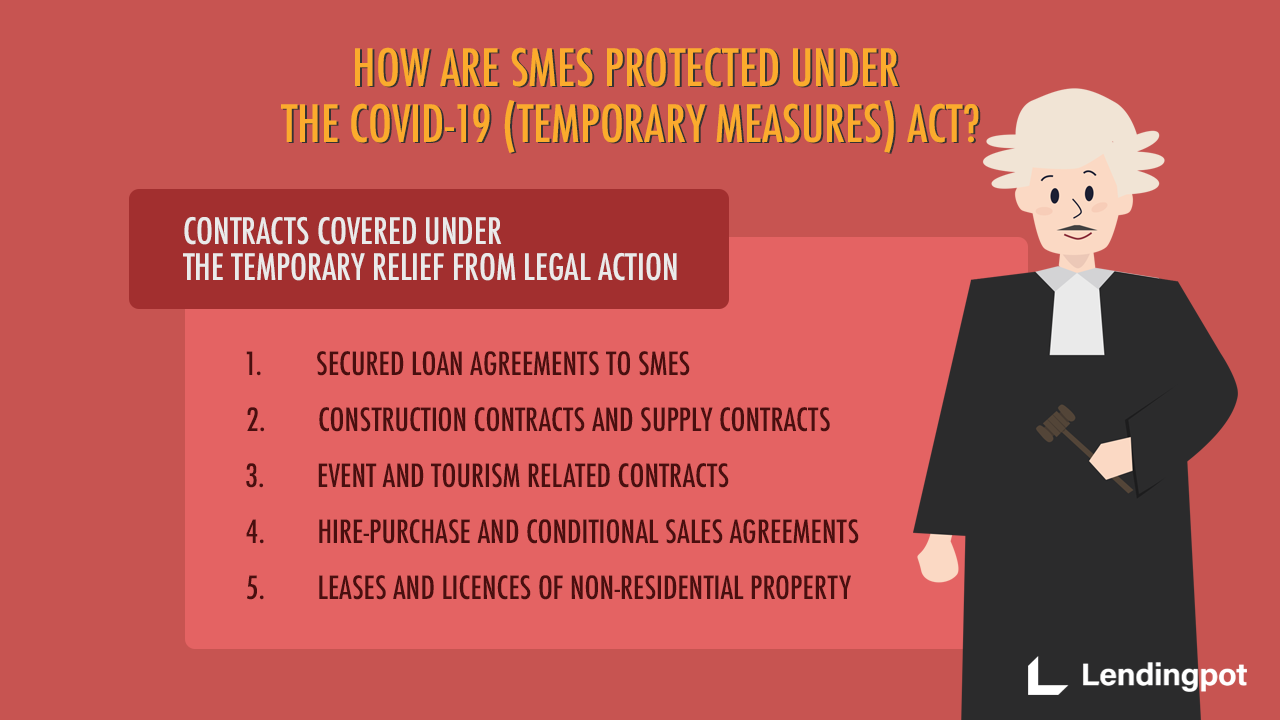
Contracts Covered Under the Temporary Relief from Legal Action

There are the 6 types of contracts covered by the act, as listed on MinLaw’s website.

  1. Secured loan agreements to SMEs
  2. Your creditor cannot enforce the security (i.e. over commercial or industrial property, plant or machinery used for business) located in Singapore
  3. Your creditor cannot start or continue court or insolvency proceedings against you (during the prescribed period)
  4. Construction contracts and supply contracts
  5. The inability to supply goods or materials due to COVID-19 is a defence to a claim for breach of contract, damages or liquidated damages
  6. The other part cannot call on any performance bond granted pursuant to the contract for the prescribed period
  7. The other party cannot start or continue court or insolvency proceedings against you for the prescribed period
  8. Event and tourism-related contracts
  9. The vendor cannot automatically forfeit the client’s deposit
  10. The deposit will be treated fairly, taking into account any expenses incurred by the vendor and alternative arrangements for the booking
  11. The client cannot be made to pay cancellation fees (if provided in the contract) if the event / tour was to occur between 1st  February 2020 to 19th October 2020 (dates inclusive)
  12. Hire-purchase and conditional sales agreements
  13. The financing company cannot repossess your plant, machinery or vehicle
  14. The financing company cannot start or continue court or insolvency proceedings against you
  15. Leases and licences of non-residential property
  16. Your landlord cannot terminate your lease or evict you, on the basis that you have not paid rent
  17. Your landlord cannot start or continue court of insolvency proceedings against you
  18. Option to purchase & sale and purchase agreements with housing developers (Amendment Bill)
  19. Booking fees or other consideration paid under Option To Purchase (OTP) cannot be forfeited
  20. Sale & Purchase (S&P) and Agreement for Lease (AFL) cannot be terminated
  21. The developer cannot impose new charges, increase charges or interest rates beyond what is provided for in the contract


via MinLaw
   via MinLaw


Are You Eligible for Relief?

MinLaw has introduced a Self-Assessment Tool for anyone who may have doubts about their eligibility.

Source: MinLaw, Secured loan agreements to SMEs, Construction contracts and supply contracts, Event and tourism-related contracts, Hire-purchase and conditional sales agreements, Leases and licences of non-residential property, Options to purchase and sale and purchase agreements with housing developers

How to Get Relief?

According to MinLaw, you are required to serve a Notification for Relief on your creditor, landlord, vendor or client using MinLaw’s form (http://www.mlaw.gov.sg/covid19-relief/notification-for-relief).

What Happens If The Other Party Does Not Agree?

You may encounter a situation when the other party does not agree to the relief.

Your creditors may feel that your inability to fulfil the contract is not due to the outbreak of COVID-19, but for other reasons.

In such instances, MinLaw encourages you to negotiate with your creditors and reach an agreement.

However, if you cannot agree, either of you may apply for an Assessor from the Ministry of Law to make a determination.

Please note that the outcome of the Assessor’s determination will be final. There will be no appeals allowed.

Steps to take:

  1. Applicant applies for an Assessor’s Determination
  2. Registrar reviews application for an Assessor’s Determination
  3. Applicant serves documents on respondent
  4. Applicant Submits Declaration of Service
  5. Respondent submits response
  6. Registrar sets appointment for hearing
  7. Assessor conducts hearing and makes Determination
  8. Registrar Informs applicant and respondent of Assessor’s Determination

You may find the full list of details here.

Hear Directly from Minister K Shanmugam

[ COVID-19 (Temporary Measures) Act – Helping Businesses & Individuals ]Spoke with Dasmond Koh on key points of the...

Posted by K Shanmugam Sc on Monday, April 27, 2020

SMEs play a critical role in Singapore’s economy. A new rental relief framework aims to give more time and support to...

Posted by Ministry of Law, Singapore on Saturday, June 6, 2020

Request for a Business Loan Now!

Lendingpot.sg operates a Business Loan Marketplace that allows an SME to connect to multiple lenders with just one application, allowing the SME to know who its prospective lenders are and the rates that they offer, in a very short time.
     Apply Now!  

In summary

About the author

Lendingpot is Singapore's leading digital loan marketplace with a diverse network of 45 lenders to match your business funding needs.

SMEs

You may also like

Products Comparisons
Why SMEs should start using InvoiceNow with DBS, OCBC & UOB
Belinda Wan
June 9, 2022
Products Comparisons
Peer-to-Peer (P2P) Lending: Funding Societies vs Validus vs Minterest
Jennifer Tjahyadi
June 13, 2022
Products Comparisons
We Compare Business Loans: Standard Chartered vs Maybank vs Citi
Lendingpot
June 16, 2022